Showing posts with label islamic funds. Show all posts

Tuesday, September 20, 2011

2011 Key Trends in Islamic Funds

Introduction

Over the last 10 years Shariah compliant funds have seen significant growth, both in terms of the number of funds as well as assets under management (AuM). Rapid developments in the Islamic finance industry, have led to an increasing number of Shariah compliant funds employing different strategies and investing across new asset classes, representing the progress and advances made in the Islamic finance sector. In this report we discuss the key trends observed in the Islamic funds industry since 2000.

The primary goal of Islamic funds is to engage in 'ethical investing' into products and companies compliant with Islamic guidelines. As such, Islamic funds are wealth management vehicles catering to investors wanting exposure to capital markets inside a Shariah framework; the key distinguishing factor from other conventional funds.

Currently, the total number of Shariah-compliant investment vehicles is estimated to be 717, with assets standing just over US$77 billion.

Figure 1: Industry growth since 2000


The Islamic fund sector underwent strong growth in 2007 witnessed by the launch of 180 funds however subsequent years have seen a decline in launch activity. Despite a slow growth rate, it is notable that the number of funds did not decrease. Islamic funds mostly invest in asset-backed securities and do not apply leverage, therefore limiting performance-based losses. Additionally, existing funds have further consolidated their positions in 2009 and 2010. As at end-July 2011, the Eurekahedge Islamic Funds Index was up 38.9% since February 2009.

New launches in 2009 to 2011 although comparatively small in number, represent increasing diversity in the industry in terms of asset classes and industry segments as well as geographies and investors. The sector has adjusted to the changed landscape post-financial crisis and has attracted attention from various quarters including western banks and investors. Sukuk issuances have picked up substantially, even from companies such as General Electric, while new Islamic funds have launched in places like Australia.

Head office locations

Malaysia and Saudi Arabia remain the most popular Islamic fund centres, boasting the most dynamic Islamic finance industry and the greatest number of investors. Saudi Arabia has recently increased its share as the fund centre of choice due to the growing popularity of retail funds among consumers as well as further strengthening of the sukuk market in the country.

One of the early movers in the industry, Malaysia launched Islamic funds early in the 1970s and further cemented its place as the leading fund centre throughout the 2000s. A liberalised Islamic banking sector with Shariah framework established in the 1980s proved to be a conducive environment for growth in the industry. In the last two years, Malaysia further strengthened its place by issuing more licenses to foreign banks, a policy that is set to continue and as such the country looks set to maintain its position as the leading Islamic fund centre in the coming years.

Figure 2: Head office locations by number of funds


Geographic mandates

While 43% of Islamic fund assets are invested in Middle East and Africa - primarily because the region holds the greatest number of companies that are Shariah-compliant - the distribution of assets across various geographic investment mandates have witnessed some significant changes over the last few years. As seen in figure 3, the Middle East/Africa mandate still accounts for the largest share of assets among the distribution of Islamic fund assets across different geographies, though this share has been declining steadily – five years ago 63% of Islamic fund assets were invested in this region. The main reasons for this decline can be attributed to the strong growth witnessed in the Islamic finance sector in other regions and the trend of diversification among Islamic funds.


Figure 3: Geographic mandates by AuM


Fund types

Figure 4 shows the breakdown by fund types in the Islamic fund industry. The majority of Islamic funds are structured as mutual funds catering to retail investors and many of the funds are overseen by well-established Shariah regulations such as the Securities Commission of Malaysia, who help to ensure that managers abide to rules designed to safeguard retail investors.

Alternative investments such as hedge funds and private equity are deemed to be risky products and only make up 10% of the fund population. However, the Islamic asset management sector has become more sophisticated over the years as investors have been exploring increased investing into real assets with a lesser focus into financial assets. As such, there is a large opportunity for Islamic institutions to explore more offerings into index tracker funds, commodity funds and other alternative funds. Commodity funds in particular are said to be well placed for Islamic investors as they comply easily with Shariah policies. 

Figure 4: Fund types by number of funds

Asset classes

Equity investments account for 40% of Islamic fund assets primarily because allocating to Shariah-compliant companies (becoming shareholders) forms the easiest method of Islamic investment. Furthermore, equities have been the best performing asset class in the last 40 years and continue to be the most popular among investors who also find it easier to understand as compared with other more complicated Islamic finance instruments. While fixed income investments account for 14% of the assets, only 7% of the funds employ a fixed income mandate, showing that there are very few but large Islamic funds focused on sukuk investments. Other asset classes are however, becoming increasingly popular as the sector develops to encompass other investments.

Figure 5: Asset classes by AuM


Performance

Over the years, Islamic funds have delivered greater and more consistent performance as opposed to other comparable investments. The Eurekahedge Islamic Funds Index has gained 35.56%[1] since its inception in December 1999. Comparatively, the DJ Sustainability Index gained 10.29% over the same period of time while the MSCI World Index lost 8.09%.

Figure 6 displays the Eurekahedge Islamic Funds Index mapped out against the DJ Sustainability Index and the MSCI World Index since December 1999, clearly showing that Islamic funds have not only outperformed, but have also delivered returns with significantly less volatility and better downturn protection. For example, in 2008 the MSCI World Index declined by 41.12% and the DJ Sustainability Index was down 42.98% while Islamic funds lost 28.53%.

Figure 6: Performance of Islamic funds vs. stock market indices


Figure 7: Performance of Islamic funds by geographic mandates


In 2011 Islamic funds investing in Europe have so far delivered the best returns, however it should be noted that very few Islamic funds employ a European mandate and all of them are invested in equities. Similarly a handful of North American Islamic funds achieved the best return in 2010. The performance of these funds was helped by positive movements in the equity markets in 2010 and also by high commodity prices, as almost half of the Islamic funds investing in North America are focused on the basic materials sector.

Islamic funds investing in the Asia Pacific region delivered the strongest performance over the past three years as a large proportion of Asia Pacific Islamic funds are invested in the Malaysian and Indonesian markets which saw remarkable growth in 2009 and 2010. The FTSE Bursa Malaysia Stock index jumped 42.31% in 2009 and 19.34% in 2010 while the Jakarta Composite Index has gained nearly 70% in the last three years.

Table 1: Performance of Islamic funds by geographic mandates

EH Asia Pacific Islamic Fund Index
EH Europe Islamic Fund Index
EH Global Islamic Fund Index
EH Middle East/Africa Islamic Fund Index
EH North America Islamic Fund Index
2011 YTD returns
1.59%
4.57%
2.29%
-2.86%
3.26%
2010 returns
11.23%
4.13%
8.23%
7.28%
12.11%
3 year annualised returns
7.13%
-1.28%
1.92%
-8.90%
0.58%

Source: Eurekahedge


Figure 8: Performance of Islamic funds by asset classes


Equity investing Islamic funds witnessed the strongest returns in 2010 primarily through excellent returns posted by underlying equity markets. In the three year annualised returns measure, Islamic fund managers who were partially or fully invested in fixed income instruments registered healthy gains as they did not suffer as much as equity investing funds during the financial crisis and the Eurekahedge Islamic Fixed Income Fund Index lost only 0.85% in 2008.

Table 2: Performance of Islamic funds by asset classes

Eurekahedge Islamic Fund Balanced Index
Eurekahedge Islamic Fund Equity Index
Eurekahedge Islamic Fund Fixed Income Index
Eurekahedge Islamic Fund Real Estate Index
Eurekahedge Islamic Fund Money Market Index
2011 YTD returns
0.07%
0.01%
2.04%
4.75%
0.26%
2010 returns
7.97%
12.21%
4.20%
-0.58%
1.14%
3 year annualised returns
2.67%
-0.84%
4.40%
-3.86%
0.60%

Source: Eurekahedge


[1] All figures given are as of end-July 2011.

Tuesday, October 19, 2010

2010 Key Trends in Islamic Funds


Introduction

The rapid development of the Islamic fund industry over the last decade represents the progress and advances made in the Islamic finance sector. The primary goal of Islamic funds is to engage in 'ethical investing' into products and companies that are acceptable to the Islamic faith. As such, Islamic funds are wealth management vehicles that cater to investors who want exposure to capital markets inside a Shariah framework, which is the key distinguishing factor from other conventional funds.[1]

Currently, the total number of Shariah-compliant investment vehicles is estimated to be 690, with assets standing just over US$72 billion. Figure 1 shows the growth in the total number of Islamic funds since 2000.

Figure 1: Industry Growth over the Years


The Islamic fund sector experienced sustained growth in 2007, which saw the launch of 180 funds. However, subsequent years have seen a decline in launch activity though it should be noted that despite a slow growth rate, the number of funds did not decrease as Islamic funds mostly invest in asset-backed securities and do not apply leverage,  hence, limiting performance-based losses. Additionally, existing funds have further consolidated their positions in 2009 and 2010 – the Eurekahedge Islamic Funds Index is up 32.17% since February 2009.

The new launches in 2009 and 2010, although comparatively small in number, represent increasing diversity in the industry in terms of asset classes and industry segments as well as geographies and investors. The sector has adjusted to the changed landscape post-financial crisis and has attracted attention from various quarters including western banks and investors. Sukuk issuances have picked up substantially, even from companies such as General Electric, while new Islamic funds have launched in places like Australia.[2]

The rest of this report gives a snapshot of the current industry make-up as well as the latest performance trends.

Industry Make-Up and Growth Trends

Malaysia and Saudi Arabia remain as the most popular Islamic fund centres as they boast the most dynamic Islamic finance industry as well as the greatest number of investors. Saudi Arabia has recently increased its share as the fund centre of choice due to the growing popularity of retail funds among consumers as well as the emergence of Islamic bond market (sukuk) in the country. Malaysia was one of the early movers in the industry, with Islamic funds launched as early as the 1970s and further cementing its place as the leading fund centre throughout the 2000s. A liberalised Islamic banking sector with Shariah framework established in the 1980s proved to be a conducive environment for growth in the industry. Malaysia further plans to issue more licenses to foreign banks in the next three years and, as such, is set to be the leading Islamic fund centre in the coming years.

Figure 2: Head Office Locations by Number of Funds


 Geographic Mandates

The majority of Islamic fund assets are invested in the Middle East and Africa region primarily because it holds the greatest number of companies that are Shariah-compliant. Furthermore, other than a handful of US- and UK-based funds, Middle East-based funds boast the highest average assets under management and managers tend to invest in the regions that they are based in. Other than the Middle East, a significant amount of capital from Islamic funds is invested with a global mandate to cater to the portfolio diversification requirements of clients.

Figure 3: Geographic Mandates by Assets under Management


 Asset Classes

Equity investments account for 40% of Islamic fund assets primarily because allocating to Shariah-compliant companies (becoming shareholders) forms the easiest method of Islamic investment. Furthermore, equities have been the best performing asset class in the last 40 years and continue to be the most popular among investors who also find it easier to understand as compared with other more complicated Islamic finance instruments. Fixed income investments account for 21% of the assets; however, only 7% of the funds employ a fixed income mandate, showing that there are very few but large Islamic funds focused on sukuk investments. Other asset classes are, however, becoming increasingly popular as the sector develops to encompass other investments.

Figure 4: Asset Classes by Assets under Management


Fund Types

Since most Islamic funds cater to the retail investor, they are structured as mutual funds and other regulated products. Regulatory oversight marks a key aspect of Islamic funds and countries such as Malaysia, which have well-established Shariah regulations, would ensure compliance through government bodies – in this case, the Securities Commission of Malaysia.

While the speculative and secretive nature of most hedge fund strategies makes it difficult to ensure Shariah compliance, there are a number of Islamic private equity funds as acquiring shares of companies can easily be brought into compliance.

Figure 5: Fund Types by Number of Funds


Performance Review

Over the years, Islamic funds have delivered greater and more consistent performance as opposed to mutual funds as well as direct investments in the markets. The Eurekahedge Islamic Funds Index has gained 21.77%[3] since its inception in December 1999 as compared with a 30.5% loss for the MSCI World Index over the same period.

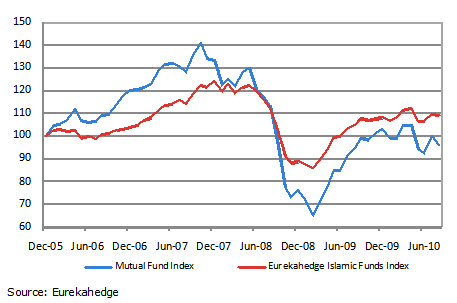
Similarly, hedge funds have delivered higher and more consistent risk-adjusted returns than mutual funds. Figure 6 displays the Eurekahedge Islamic Funds Index mapped out against the Eurekahedge Bespoke Mutual Funds Index since December 2005. Over this period, Islamic funds returned 8.99% as opposed to a 4.20% loss in mutual funds – an outperformance of more than 12%. Furthermore, in addition to better returns, Figure 6 clearly shows that Islamic funds are less volatile in nature and also provide better downturn protection as compared with mutual funds.

Figure 6: Islamic Funds vs Mutual Funds

The results posted by the Islamic funds over the last few years show that ethical investing does not necessarily have to come at the cost of lower returns. Additionally, most of these funds are structured as mutual funds and hence, the benefits are readily available to retail investors.

Table 1 and Figure 7 compare the performance of Islamic funds investing in equities with socially responsible investing and the world equity markets.

Table 1: 3-Year Performance of Islamic Funds vs Stock Market Indices


Eurekahedge Islamic Funds Equity Index
Dow Jones Sustainability Index
MSCI World
Index
12-Month Returns
3.43%
-0.30%
0.28%
YTD 2010 Returns
0.08%
-8.67%
-6.40%
3-Year Annualised Returns
-4.48%
-9.94%
-11.87%
3-Year Annualised Standard Deviation
18.24%
25.00%
20.38%


Figure 7: 3-Year Performance of Islamic Funds vs Stock Market Indices


The Eurekahedge Islamic Fund Equity Index registered a 12-month return of 3.4%, beating other broad stock market indices which were either negative or flat. With the help of good risk management systems and by sticking to a limited universe of Shariah-compliant stocks, Islamic managers also outperformed traditional long-only equity investment mandates. In particular, Islamic funds avoided companies that are deemed speculative in nature such as highly geared firms. In the widely cited 'new normal' environment where credit is hard to get, these highly leveraged firms are expected not to perform very well.

Figure 8 tracks the same three indices over the longer term.

Figure 8: Islamic Equity Funds vs Stock Market Indices over the Years


The Eurekahedge Islamic Fund Equity Index has gained 11.8% since December 1999, whereas the MSCI World Index lost 30.5% and the Dow Jones Sustainability Index was down 8.9% over the same period. Furthermore, out of these three investments, Islamic funds suffered the least drawdown during the 2008 financial crisis.

Figure 9: Performance of Islamic Funds by Investment Geographic Mandates


Figure 9 shows the performance of Islamic funds across geographic mandates. Islamic funds investing in the Asia Pacific region delivered the strongest performance over the past three years, 12 months and in 2010 (2.48%, 2.79% and 7.22%, respectively). A large proportion of Asia Pacific Islamic funds are invested in the Malaysian and Indonesian markets, which underwent remarkable growth in 2009 and 2010. The FTSE Bursa Malaysia Stock index jumped 11.8% YTD August while the Jakarta Composite Index was up 21.6%. Indonesian stocks have reached all-time highs and the re-election of President Yudhoyono has prompted expectations of another era of political stability and strong economic growth in the country.

 Table 2: Performance of Islamic Funds by Investment Geographic Mandates


Eurekahedge
Asia Pacific Islamic Fund Index
Eurekahedge
Global
Islamic Fund Index
Eurekahedge
Middle East/Africa Islamic Fund Index
12-Month Returns
7.22%
3.13%
-1.72%
YTD 2010 Returns
2.79%
-2.48%
1.15%
3-Year Annualised Returns
2.48%
-1.95%
-6.49%
3-Year Annualised Standard  Deviation
11.46%
11.42%
15.81%
% Below HWM
-1.33%
-10.60%
-29.00%


Figure 10: Performance of Islamic Funds by Instrument Traded


Islamic fund managers who were partially or fully invested in fixed income or money market instruments have registered healthy gains over the last few years. Islamic funds benefited from rallies in the Islamic bond market – the HSBC/NASDAQ Dubai US Dollar Sukuk Index, which tracks a basket of Islamic bonds, posted gains to the tune of 11.1% in the first three quarters of this year. With more capital being employed in the Middle East and Asian Islamic bond markets, managers in the sector look well set to further extend their positive run.

Table 3: Performance of Islamic Funds by Instrument Traded


Eurekahedge Islamic Fund Balanced Index
Eurekahedge Islamic Fund Equity Index
Eurekahedge Islamic Fund
Fixed Income Index
Eurekahedge
Islamic Fund
Money Market Index
12-Month Returns
5.10%
3.44%
3.71%
2.95%
YTD 2010 Returns
0.82%
0.08%
2.26%
1.46%
3-Year Annualised Returns
0.02%
-4.48%
3.32%
3.04%
3-Year Annualised
Standard Deviation
12.19%
18.24%
1.09%
3.48%
% Below HWM
-9.72%
-21.97%
0.00%
0.00%


Conclusion

The Islamic fund sector has continued to mature and develop rapidly, expanding into new asset classes as well as regions. Despite the industry suffering some setbacks during the financial crisis, Islamic funds rebounded sharply in the last 18 months and delivered excellent returns. Furthermore, the sector has outperformed not only the underlying markets but also other comparable investments such as mutual funds, showing that the quest for profit is not necessarily at odds with ethical investments.

Going forward, we expect Islamic fund managers to continue outperforming the markets while also expanding to cover new instruments and asset classes. The industry continues to gain traction among investors and we anticipate further growth through asset flows and fund launches in the next few years.

[1] For a more detailed description of what constitutes Islamic investing, please refer to the Eurekahedge Key Trends in Islamic Funds report published in January 2010. www.eurekahedge.com/news/10_jan_EH_IF_KeyTrends_Full_ABR.asp
[2] Please go to www.eurekahedge.com/news/attachments/KeyTrends/EH_IF_2010_KeyTrends.pdf to learn more about the developments in the Islamic fund industry.
[3] All figures given are as of end-August 2010.